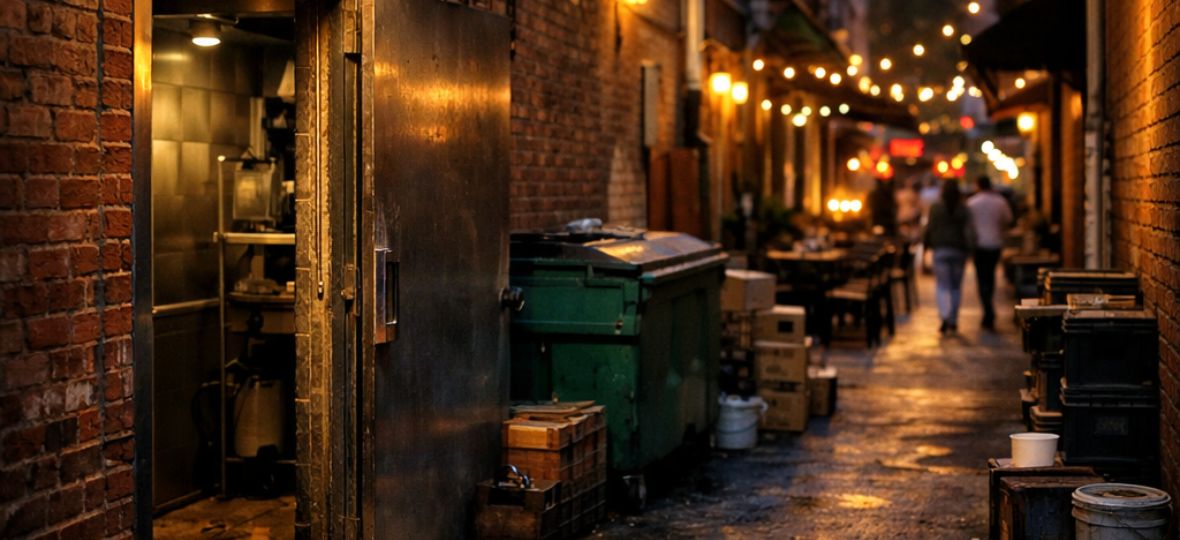
The Forsyth County Environmental Health Department inspects food-service operations on a scored system where active rodent evidence — a single fresh dropping, a live sighting, gnaw marks on food packaging — constitutes a critical violation. A critical violation triggers a mandatory re-inspection within days and can result in permit suspension pending corrective action. For a downtown Winston-Salem restaurant, that sequence of events is existential in a way that a citation for a broken floor tile is not.
Why the Innovation Quarter Has Persistent Rat Pressure
The Innovation Quarter's rodent pressure is structural, not sanitary. A restaurant in the 4th Street or Trade Street corridor that maintains spotless interior sanitation can still face a Norway rat health-code violation because the pressure driving rats into the building comes from outside the building — from the combination of restaurant-density food waste in the loading-dock and alley zone, the city's oldest sewer infrastructure beneath the downtown street grid, and the older masonry foundation gaps that provide below-grade entry from the utility trenches where Norway rats travel.
This means that sanitation improvements alone will not resolve a Norway rat problem in the Innovation Quarter. The rats are not inside because the kitchen is dirty; they are inside because the loading-dock threshold seal is worn and the alley dumpster cluster 30 feet away sustains a population large enough to probe every nearby building entry point every night.
What a Health Inspection Wants to See
When a Forsyth County health inspector issues a critical violation for rodent evidence and schedules a re-inspection, the inspector is looking for documented corrective action — a dated service record showing that a licensed pest-control provider was contacted, the evidence was assessed, and treatment was deployed. The record needs to show:
- Date and time of service
- Evidence found and its location
- Treatment deployed and where
- Any exclusion work performed or recommended
- Follow-up schedule
We provide this documentation on the same day as service. For a re-inspection scheduled 48 to 72 hours after the original violation, that timeline is tight — call immediately when the violation is issued, not the morning of the re-inspection.
The Preventive Program: What It Looks Like for a Downtown Restaurant
A preventive rodent program for a downtown Winston-Salem food-service operation has three components. First, exterior perimeter bait stations at the loading dock, dumpster enclosure, utility penetrations, and building corners — tamper-resistant stations stocked with compliant rodenticide bait and serviced monthly. This addresses the external Norway rat population pressure that drives rats to probe building entry points. Second, exclusion of the loading-dock threshold and all identified foundation-grade entry points — the sealing work that reduces the probability of a rat that reaches the building exterior finding its way inside. Third, an interior trap program in non-food-contact positions — snap traps under equipment bases and in protected utility chases — that catches any animal that does get inside before it reaches food-contact surfaces.
The perimeter program is the element that most commercial operators skip because it is not visible to customers and doesn't produce a dramatic obvious result. It is also the element that prevents the violation in the first place. The trap inside the kitchen catches the rat after it has already entered and potentially contaminated a surface; the perimeter station catches it before it reaches the building.
Scheduling Around Service Hours
Interior inspection and trap placement in a food-service kitchen cannot happen during prep or service hours in most cases. The scheduling we use for downtown Winston-Salem restaurants: exterior perimeter station service any time, including during service hours with minimal disruption; interior inspection and trap deployment before kitchen prep hours begin (typically 6:00 to 8:00 AM) or after closing. We confirm the specific timing with kitchen management before every visit and maintain a flexible schedule to accommodate the operational realities of food-service operations.
Questions About Your Winston-Salem Property?
Free inspection. Written quote. Open 24/7 across Forsyth County.