Rodent bait station installation is the placement and maintenance of tamper-resistant exterior rodenticide bait stations — the perimeter-control component of rat programs for properties where Norway rat pressure from adjacent sewer infrastructure, landscaping, or neighboring sites creates ongoing population pressure that interior trapping alone cannot address. Bait stations are deployed on the exterior perimeter, not inside occupied residential spaces — they are an outdoor tool calibrated to Norway rat behavior and NC structural pest control regulations.
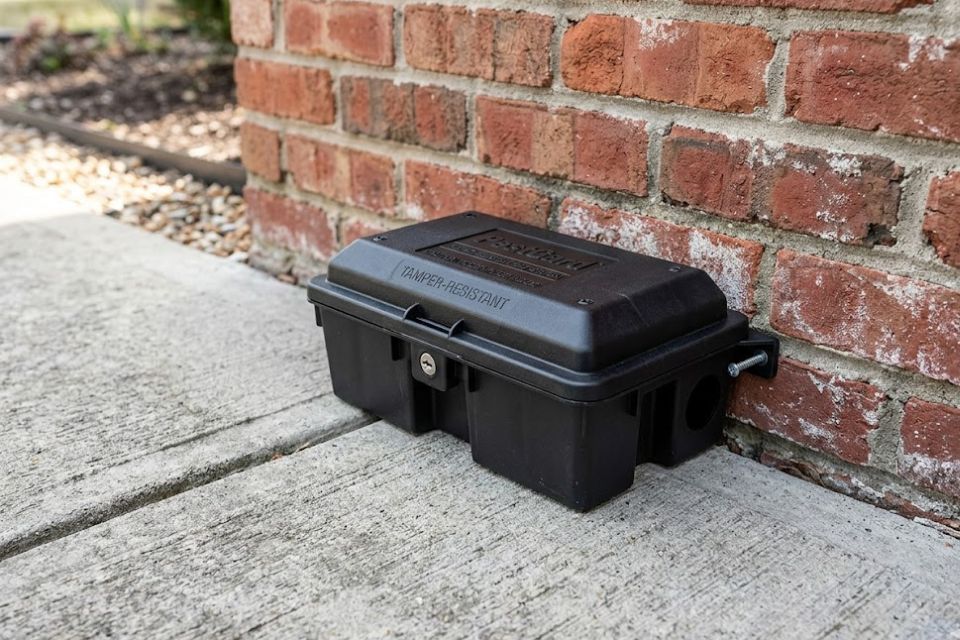
A tamper-resistant bait station is a locked, weather-resistant plastic housing sized to allow rat entry but too small for children, pets, and most non-target wildlife. The NC structural pest control board requires tamper-resistant housing for any exterior rodenticide deployment. Stations are secured to the ground or a fixed surface, labeled per regulatory requirements, and stocked with first- or second-generation anticoagulant rodenticide bait in block or pellet form. Each station is serviced on a schedule tied to bait consumption — high-consumption stations indicate active pressure and receive more frequent checks.
Exterior bait stations are appropriate where Norway rat pressure comes from outside the structure — sewer-adjacent properties in Old Salem and West Salem, commercial properties with loading-dock access, and warehouse perimeters along industrial corridors. They are the lead tool for exterior perimeter programs and a supplement — not a replacement — for interior snap-trap programs on active infestations.
Stations are placed at burrow entrances, along foundation walls within 6 inches of the building perimeter, near loading dock corners, at landscaping perimeter transitions, and at utility penetrations — the locations Norway rats actually travel. Placement at random intervals without regard to actual runway evidence is ineffective. Every station placement is mapped and documented.
Written quote. Open 24/7. Same-day available for active situations.
Tamper-resistant bait stations are rated to resist access by children and most domestic pets per NC structural pest control board requirements. The station housing requires deliberate manipulation to open. We also discuss placement specifics on every job to keep stations out of high-pet-traffic areas where additional caution is warranted.
No. We do not deploy rodenticide bait stations inside occupied residential spaces. The risk of a rodent dying in a wall void after ingesting interior bait — creating a decomposition-odor problem that is expensive to resolve — is not worth the marginal benefit over snap-trap programs.
Service frequency is driven by bait consumption. High-pressure exterior locations adjacent to sewer infrastructure typically need monthly service. Lower-pressure perimeter programs can run quarterly. We set the initial frequency based on the site survey and adjust after the first two service cycles.
Initial installation for a residential perimeter program typically runs $200–$500 for 4–8 stations including the first bait loading. Commercial perimeter programs with more stations run $400–$1,200 at installation. Ongoing service visits run $80–$200 per visit depending on station count and travel. Free site assessment; written quote before installation.