Free Inspection · Same-Day Available

Roof Rat Removal Services in Winston-Salem, NC

Roof rat removal service is the species-specific elimination of Rattus rattus — the black rat — from attics, ceiling voids, and upper building structures. In Winston-Salem, roof rat pressure is concentrated in the mature-canopy belt west of downtown: Reynolda Park, Buena Vista, Mount Tabor, Forest Hills, Old Town, and West Highlands, where overhanging hardwoods give these climbers direct access to every roofline they can reach.

📞 Call (844) 635-0403All 28 Services
Technician on a ladder performing roofline exclusion for roof rats in Winston-Salem
The Reynolda Canopy Problem

Why West Winston Has a Roof Rat Problem Unique in the Piedmont

Roof rats are native to southeast Asia and spread globally as stowaways. They thrive in warm climates with abundant tree cover — and Winston-Salem's Reynolda corridor delivers exactly that. Reynolda Gardens, established in the 1910s on the R.J. Reynolds estate, anchors a band of mature hardwood canopy that runs east through Buena Vista, Mount Tabor, Forest Hills, and Old Town. Oaks, hickories, maples, and tulip poplars now reaching 50–80 feet provide aerial travel routes that roof rats use as reliably as roads.

The pattern is consistent: a roof rat moves along a limb that overhangs a home's roofline, drops onto the soffit or fascia, and enters through a wood-rot gap, an unscreened gable vent, or a construction void at a dormer transition. Once inside the attic, a pair establishes within a few weeks. By the time the homeowner hears scratching overhead, there are typically 6–15 individuals in the attic space.

Piedmont NC's climate is also a factor. Forsyth County's average January low of 29°F is mild enough that roof rats don't experience the sustained cold that limits their range further north. They breed year-round here, with a peak pressure period from September through March when cooling temperatures push populations to move into new harborage.

The critical distinction from Norway rats: roof rats almost never enter from the ground. If you're hearing scratching exclusively from overhead — ceiling voids, attic — the species is almost certainly a roof rat, and the treatment approach is fundamentally different from ground-level rodent control.
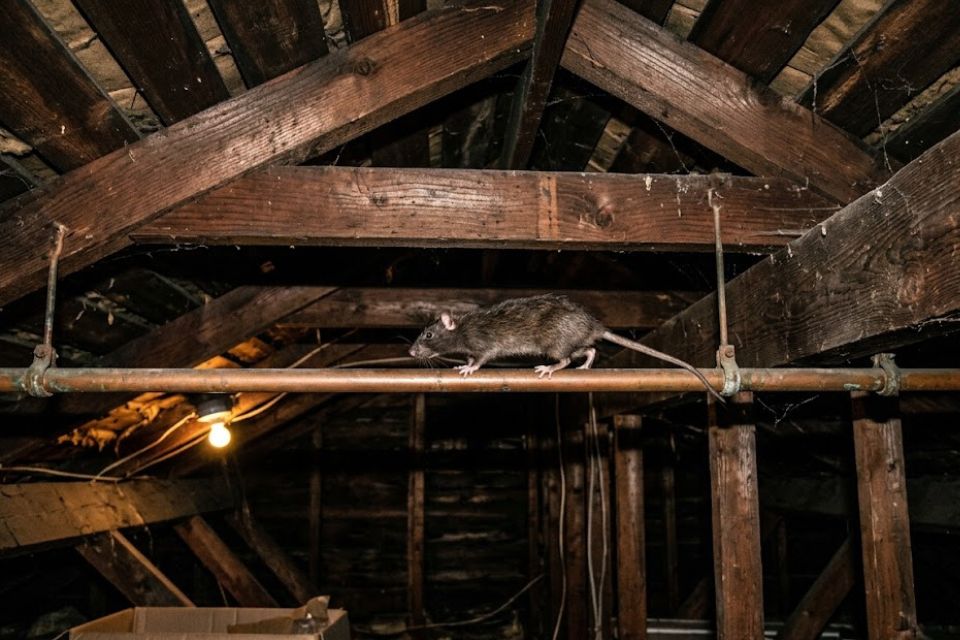
Roof Rat — Winston-Salem ProfileDetail
SpeciesRattus rattus (black rat, ship rat)
Body size6–8 inches, 5–9 oz
TailLonger than body — key ID feature
Dropping1/2 inch, pointed at both ends
HabitatAttic, ceiling void, soffit, wall cavities above first floor
Entry methodTree-access to roofline: soffit gaps, gable vents, dormer voids
Minimum entry gap1/2 inch (quarter diameter)
WS hotspotsReynolda Park, Buena Vista, Mount Tabor, Forest Hills, Old Town, West Highlands
Peak seasonSep–Mar; year-round in Forsyth County
Key damageAttic insulation contamination, HVAC duct gnawing, wiring
Tree-access rule

Any tree limb overhanging within 6 feet of a roofline surface gives a roof rat viable access. Exclusion without addressing tree proximity will fail — new rats will enter as fast as the sealed ones are removed. We coordinate with arborists when tree trimming is needed before exclusion work begins.

Our Process

How Roof Rat Removal Works in Winston-Salem

Attic Inspection

Full attic walk — insulation surface survey for runways and droppings, rafter inspection for gnaw marks, full perimeter check of soffit, gable vents, ridge cap, and all penetrations. Entry points mapped before treatment begins.

Tree Access Assessment

Exterior walkthrough to identify overhanging limbs within 6 feet of any roofline surface. Trimming needs documented and coordinated — exclusion is premature if tree access is still available.

Attic Trap Deployment

Snap-trap stations placed along attic insulation perimeter and on rafters at runway locations. Elevated bait stations deployed on exterior roofline or in attic access where appropriate. Quantity scaled to inspection findings.

Roofline Exclusion

Soffit voids sealed with painted aluminum flashing. Gable vents fitted with 1/2-inch hardware-cloth inserts or replaced with pre-screened vents. Dormer transitions and penetrations sealed with metal flashing plus expanding foam. Ridge-cap gaps sealed.

Follow-Up & Verification

Return visit to assess trap catches, confirm no new entry evidence, and verify exclusion integrity. Attic cleanup and insulation replacement quoted separately if warranted by contamination level.

Honest Pricing

Roof Rat Removal Costs in Winston-Salem

ServiceTypical RangeNotes
Free Inspection$0Attic + exterior roofline + tree-access assessment. Written report.
Roof Rat Trapping Program$400–$800Attic snap-trap array + bait stations + one follow-up visit
Roofline Exclusion$700–$2,000Soffit, gable vents, dormer voids, penetrations. Linear footage drives cost.
Full Program (trap + exclude)$1,000–$2,600Treatment + full exclusion + verification. Larger West Winston homes trend high.
Add: Attic Cleanup$500–$1,500Contaminated insulation removal + HEPA disinfection. Quoted post-treatment.
Add: Insulation Replacement$1,200–$3,500Per attic sq footage. Required when saturation is extensive.

Larger 1920s–1960s homes with complex rooflines in Buena Vista, Forest Hills, and Old Town trend toward the upper end. Free inspection always. Written quote before any work.

Roof Rat Removal Across the Reynolda Canopy Belt — Free Inspection

Same-day available. Open 24/7. Written quote before any work begins.

📞 Call (844) 635-0403
High-Pressure Zones

Roof Rat Neighborhoods in Winston-Salem

Heaviest Pressure

Reynolda Park & Buena Vista

Directly adjacent to Reynolda Gardens and its mature hardwood canopy. Overhanging limb coverage is dense on most residential lots. The 1920s–1950s housing stock has wood-fascia and soffit construction that develops entry gaps over decades. Roof rat pressure here is year-round rather than seasonal.

High Pressure

Mount Tabor & Forest Hills

Established residential neighborhoods with large lots and mature canopy extending from Reynolda Road south to Jonestown Road. Similar housing era and construction characteristics to Buena Vista, with the added factor of Forsyth County's highest average lot size in this segment, meaning more linear soffit footage per property.

Significant Pressure

Old Town & West Highlands

West of Reynolda Road and north of University Parkway. Mix of canopy density and older construction. Old Town in particular has some of the most complex roofline geometry in Winston-Salem — multiple dormers, steep pitches, and original-construction valleys that create roof-rat entry points that are difficult to locate without a systematic attic inspection.

Emerging Pressure

Sherwood Forest & South Fork

Newer subdivisions to the southwest with younger canopy that is now reaching roof-access height on some lots. Roof rat pressure in these neighborhoods is lower than the Reynolda belt but rising as trees mature. First-generation infestations in newer construction typically enter through construction gaps at HVAC penetrations.

Common Questions

Roof Rat Removal FAQs

What neighborhoods in Winston-Salem have the worst roof rat problems?

The mature-canopy belt is the key driver. Reynolda Park, Buena Vista, Mount Tabor, Forest Hills, Old Town, and West Highlands all have significant hardwood canopy that provides tree-access highways to rooflines. Properties where tree limbs overhang within 6 feet of any roofline surface are at highest risk.

How do roof rats get into an attic?

Roof rats are climbers and enter almost exclusively from above. The most common entry points in Winston-Salem's older housing stock are open soffit voids, damaged or unscreened gable vents, gaps at dormer-to-roof transitions, roofline penetrations around plumbing stacks and HVAC lines, and unsealed ridge-cap joints. A rat can compress through any gap larger than 1/2 inch.

Can I solve a roof rat problem just by trapping without exclusion?

No. Trapping reduces the active population in the attic, but roof rats in the canopy belt will continue entering through the same soffit and gable-vent gaps as long as those openings remain. The only durable solution is attic trapping combined with roofline exclusion and — for properties with overhanging tree limbs within 6 feet — tree trimming to eliminate the access route.

What does roof rat removal cost in Winston-Salem?

Roof rat treatment typically runs $400–$800 for the trapping program. Attic exclusion — sealing soffits, gable vents, and roofline penetrations — adds $700–$2,000 depending on roofline complexity and linear footage. Attic cleanup of contaminated insulation is quoted separately after the trapping phase is complete.

How long does roof rat removal take?

Most roof rat jobs in Winston-Salem's canopy belt run 3–5 weeks from first treatment to verified knockdown. The longer timeline compared to mouse control reflects both the larger territory roof rats cover and the requirement to seal roofline penetrations that may only be safely accessible in specific weather conditions. We don't rush exclusion work.

Related Services

Often Combined with Roof Rat Removal

📞 Call (844) 635-0403 — Open Now