Insulation replacement after rodent damage is the removal and replacement of attic or crawl-space insulation contaminated by rat or mouse urine, droppings, and nesting to the point where decontamination alone is insufficient. A roof rat colony active for one or more seasons in a Winston-Salem attic can saturate the entire insulation layer — the urine disperses through blown insulation and cannot be fully removed by surface disinfection alone. Replacement restores both thermal performance and sanitary condition.
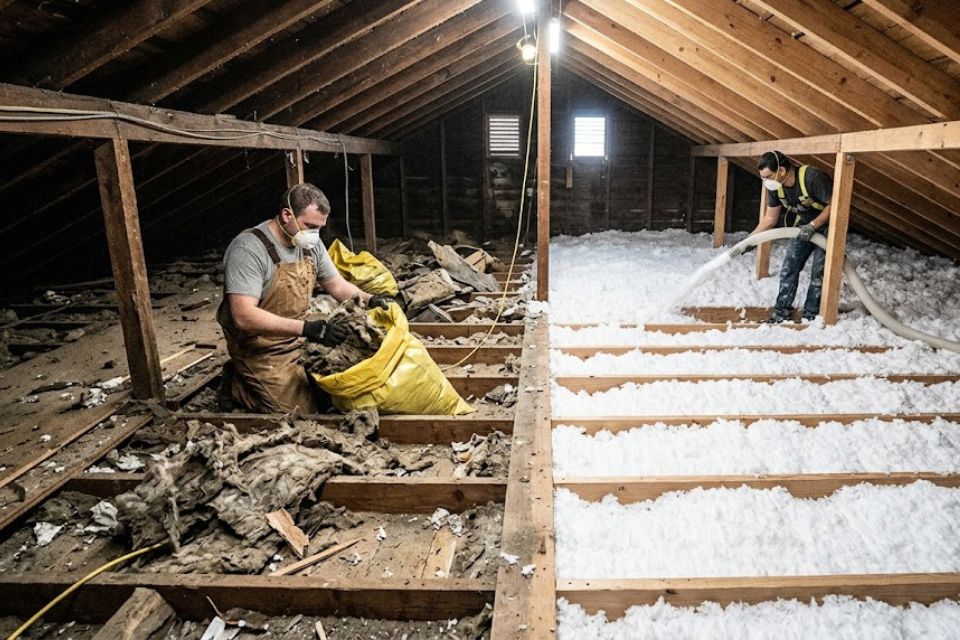
The decision to replace insulation is made based on four criteria observed during the post-treatment inspection: saturation level (more than 30–40 percent of the layer affected by urine distribution), compression and R-value loss from prolonged nesting, the presence of multiple large nest sites embedded in the insulation, and the age and pre-existing condition of the insulation independent of rodent damage. We provide a written assessment documenting each criterion and a clear recommendation — not a blanket replacement pitch on every job.
The full scope: removal of all existing insulation by HEPA-rated vacuum and manual bagging, HEPA disinfection of all exposed framing and sheathing, inspection of framing for gnaw damage needing structural attention before new insulation is installed, and installation of new blown or batt insulation to current NC energy code R-value requirements for Forsyth County.
Crawl-space insulation — typically faced fiberglass batts stapled to floor joists — is more susceptible to urine saturation than blown attic insulation because the kraft facing retains moisture. Norway rat nesting in crawl-space insulation creates contamination that cannot be remediated in place. Replacement in this zone is combined with vapor barrier assessment and foundation vent retrofitting as part of the full crawl-space rodent remediation scope.
Written quote. Open 24/7. Same-day available for active situations.
The inspection after treatment completion assesses what proportion of the insulation layer shows urine saturation, whether multiple large nest sites are embedded in the insulation, the R-value loss from compression and moisture, and the age and pre-existing condition of the insulation. We provide a written recommendation based on those findings.
The standard for Winston-Salem attics is blown cellulose or blown fiberglass to meet current NC energy code requirements — R-38 minimum for most Forsyth County residential applications. Batt insulation is used in some crawl-space applications. Material selection is documented in the written scope.
Attic insulation removal and replacement for a typical Forsyth County home (1,200–2,000 sq ft attic footprint) runs $2,000–$5,000 depending on insulation depth, access difficulty, and disposal logistics. Crawl-space insulation replacement runs $1,200–$3,500 depending on linear footage and access conditions. Free assessment after rodent treatment; written quote before any insulation work begins.