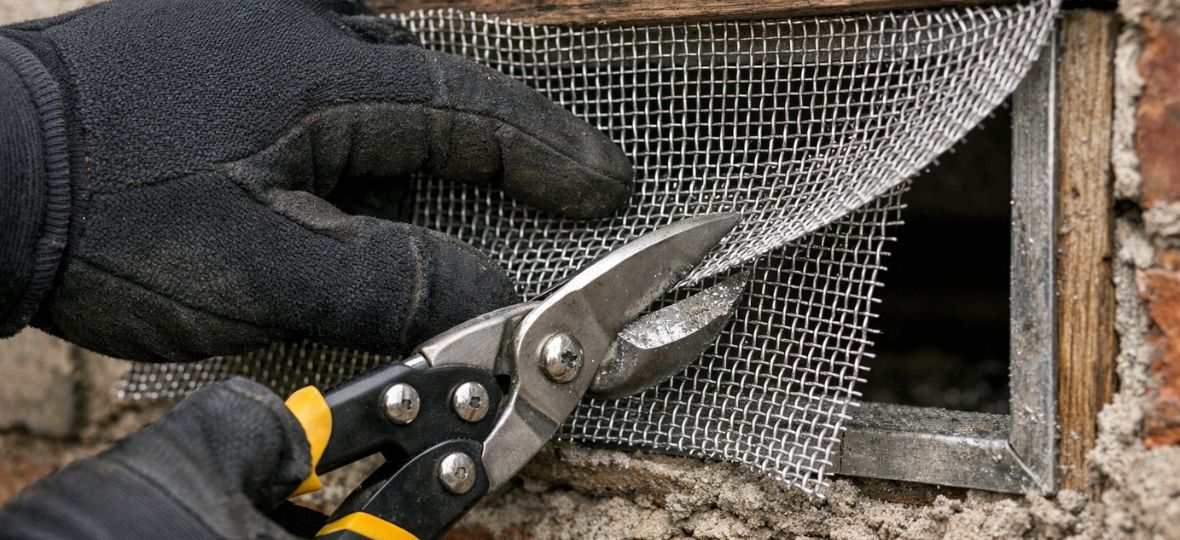
Rodent exclusion is the physical closure of every gap, crack, and penetration that a rat or mouse can use to enter a building. It is distinct from trapping (which removes animals currently inside) and baiting (which kills animals that contact the bait), because it prevents new animals from entering rather than managing the ones that do. The pest-control industry's recurring-visit model is built around trapping and baiting; exclusion produces a one-time resolution that requires no follow-up visits unless new entry points develop.
The Problem with Trapping Without Exclusion
A snap-trap array in an Ardmore bungalow with 20 open entry points catches mice from the population currently inside. Within a week, the population is reduced. Within a month, the catches stop. The homeowner assumes the problem is resolved. Within the next 60 to 90 days, new mice have entered through the same gaps, established their own runways, and the population rebuilds to pre-treatment levels. This is not a treatment failure — it is the predictable result of treating the symptom (active mice) without addressing the cause (open entry points). The cycle continues until the entry points are sealed.
The Inspection: Finding Every Entry Point
The exclusion inspection is more demanding than a standard pest inspection because it requires identifying every gap above the exclusion threshold — 1/4 inch for mice, 1/2 inch for rats — on the entire property. This includes:
- All kitchen and bathroom supply-line penetrations through cabinet base floors and wall plates
- All HVAC flex-duct sleeve penetrations through interior walls and exterior plates
- Dryer-vent louvers and the gap between the duct and the sleeve
- Crawl-space foundation vents — condition of screening, gap around frame
- Exterior access panel perimeter gap
- Brick-pier and masonry foundation mortar joint condition
- Utility sleeve penetrations (water, gas, electrical) through the foundation wall
- Door sweeps and threshold conditions on all exterior doors
- Garage door threshold seal condition
- Soffit voids, gable vents, and roofline penetrations (for roof rat exclusion)
A pre-1970s Winston-Salem home typically has 15 to 30 identifiable entry points on a thorough inspection. A post-1990 home typically has 6 to 15. The inspection produces a written entry-point map that forms the basis of the exclusion scope and quote.
Materials and Methods
Every gap gets the material appropriate to its location, size, and the construction era of the building. The primary materials in a Forsyth County residential exclusion program:
- 1/4-inch stainless-steel hardware cloth: The workhorse of rodent exclusion. Gnaw-resistant, corrosion-resistant, and available in rolls that can be cut to any shape. Used at crawl-space vents, soffit voids, gable-vent retrofits, and any structural gap where a rigid insert is appropriate. For mouse exclusion, 1/4-inch mesh. For rat exclusion, 1/2-inch mesh is sufficient but 1/4-inch works for both.
- Painted aluminum or steel flashing: Used for soffit sealing and roofline transitions — any location where a flat metal surface is needed to close a gap flush with existing roofing or siding. Painted to match existing color.
- Paintable siliconized caulk: Used as the perimeter seal around mesh inserts at plumbing penetrations — not as a standalone seal, which mice can chew through, but as a supplement that seals the edge of the mesh to the surrounding surface.
- Expanding foam with capsaicin additive: Used as a backer behind mesh inserts in wall cavities, not as a standalone gap filler. Adds deterrent effect to the primary mechanical barrier.
- Heavy-gauge door sweeps: Steel or aluminum-frame neoprene door sweeps rated to close gaps to 1/8 inch. Not the hardware-store bristle sweep that wears out in a season.
- Lime-compatible mortar (historic properties): For brick-pier mortar joint repairs on pre-1920s construction where Portland cement would damage original brick.
Treatment and Exclusion Sequencing
The sequencing of treatment and exclusion matters. For an active infestation, sealing entry points before the active population is removed traps animals inside the building — creating a decomposition problem as trapped animals die in inaccessible spaces. The standard sequence is: trap program first to achieve population knockdown, then exclusion sealing to close the entry points. For light infestations (isolated incident, one confirmed entry point), treatment and exclusion can happen simultaneously in a single visit.
What Exclusion Does Not Cover
Physical exclusion seals the building envelope against rodent access. It does not eliminate external population pressure — Norway rats in the Old Salem sewer zone, roof rats in the Reynolda canopy, field mice in the agricultural land adjacent to rural-edge properties continue to exist and to probe for entry points. If new gaps develop over time — settling opens a new floor-plate void, a tree limb grows to roofline proximity, a door sweep wears out — those new entry points are outside the scope of the original exclusion job. This is why the written prevention report that accompanies every exclusion job is important: it identifies the ongoing risk factors (overhanging trees, landscape harborage, aging materials) that aren't fixed by sealing today's gaps, and what to watch for.
The 12-month guarantee: We guarantee every sealed entry point for 12 months — if a point we sealed fails and rodents re-enter through that specific gap, we reseal at no charge. We do not guarantee against new entry points that develop after the job is complete, which would be equivalent to guaranteeing that the house will not age. The guarantee covers our work; the prevention report covers the ongoing maintenance the homeowner needs to watch.
Questions About Your Winston-Salem Property?
Free inspection. Written quote. Open 24/7 across Forsyth County.