Rodent control in Winston-Salem starts with a single critical question: what species are you dealing with? A roof rat treatment protocol applied to a Norway rat problem fails. A mouse exclusion program that seals to 1/4-inch tolerance does nothing about a roof rat entering through a 3/4-inch soffit gap. Getting the identification right before any trap is set is not a formality — it is the entire job.
Norway Rats in Winston-Salem
Norway rats (Rattus norvegicus) are the larger, heavier species — 7 to 10 inches of body, 12 to 18 ounces, with a blunt snout and a tail shorter than the body length. They are ground-level animals. In Winston-Salem, Norway rats concentrate in the oldest infrastructure zones: Old Salem's brick-pier foundations, the sewer-adjacent residential blocks of West Salem and Southside, and the downtown commercial corridor where aging utility infrastructure provides the below-grade harborage they prefer.
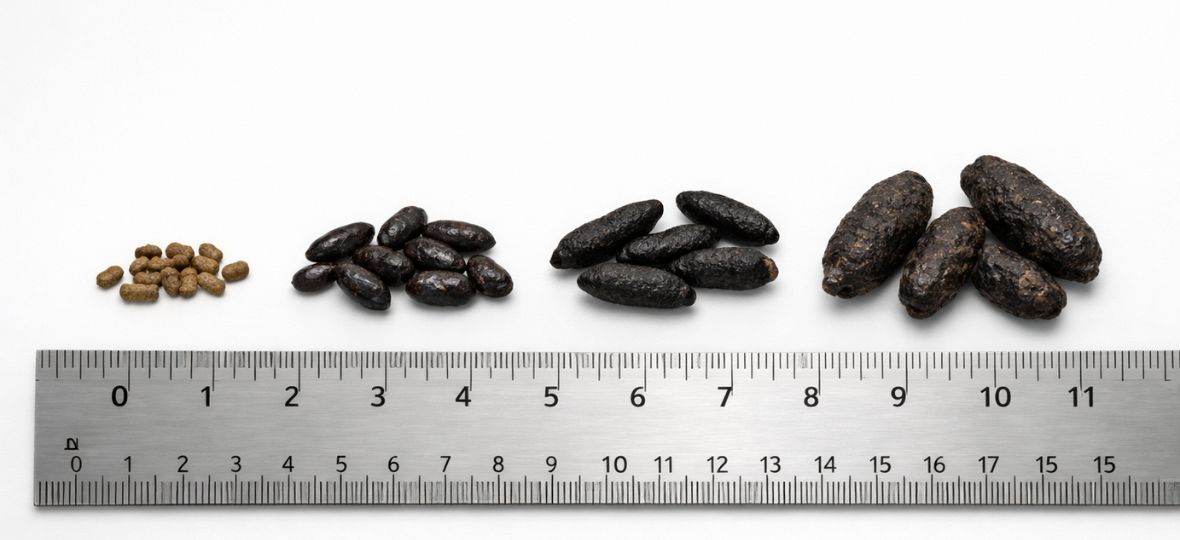
Key identification signs: Blunt-ended droppings measuring 3/4 inch, found along foundation-level runways, in basements, in crawl spaces, and near exterior burrow entrances. Burrow holes 3 to 4 inches in diameter near foundation walls, under concrete slabs, or adjacent to compost and debris piles. Gnaw damage at grade level on structural lumber, PVC supply lines, and electrical conduit below the first-floor plate.
Norway rat activity in Winston-Salem peaks between January and March when population dispersal from the city's sewer infrastructure pushes rats outward into residential and commercial properties at the foundation line. The treatment lead for Norway rats is exterior perimeter bait stations combined with foundation-grade exclusion — not attic trapping.
Roof Rats in Winston-Salem
Roof rats (Rattus rattus) are the climbers — 6 to 8 inches of body, 5 to 9 ounces, with a slender build, large ears, and a tail that is distinctly longer than the body. They live overhead. In Winston-Salem, roof rat pressure concentrates in the mature-canopy belt that runs from Reynolda Gardens through Reynolda Park, Buena Vista, Mount Tabor, Forest Hills, and Old Town — anywhere that 50- to 80-foot hardwoods provide aerial travel routes to rooflines.
Key identification signs: Pointed-ended droppings measuring 1/2 inch, found in attic insulation, along rafters, and in ceiling void spaces — not at ground level. Scratch and thump sounds from overhead (ceiling, attic) rather than from beneath the floor. Gnaw marks on attic wood framing, HVAC flex duct, and wiring. Grease rub marks along rafter runs in the attic rather than along wall-base runways below.
The treatment lead for roof rats is attic snap-trap deployment combined with roofline exclusion — soffit sealing, gable-vent retrofitting, and tree-access assessment. Exterior perimeter bait stations that work for Norway rats are largely irrelevant for a roof rat problem because roof rats are not accessing through the foundation.
House Mice in Winston-Salem
House mice (Mus musculus) are the smallest and most pervasive species — 2.5 to 3.5 inches of body, 0.5 to 1 ounce, with large ears relative to body size. They are opportunists rather than specialists: they nest in wall voids, kitchen cabinets, attic insulation edges, and any protected space within 30 feet of a food source. In Winston-Salem, house mice are present in every neighborhood but concentrate most heavily in the pre-1970s housing stock of Ardmore, the West End, Holly Avenue, Washington Park, and Boston Thurmond — where construction-era tolerances create dozens of entry points per property.
Key identification signs: Rice-grain droppings measuring 1/4 inch, pointed at both ends, found near food sources — under kitchen sinks, inside pantries, in cabinet bases — rather than along structural runways. Gnaw marks on cardboard, soft plastics, and wiring insulation. Scratching sounds from wall voids, most audible at night when mice are most active. Rub marks along wall-base baseboards in areas of high activity.
The treatment lead for house mice is snap-trap arrays in protected runway positions combined with sub-1/4-inch gap sealing throughout the property. The entry standard for mouse exclusion (1/4 inch) is twice as demanding as for rat exclusion (1/2 inch) — a fact that makes mouse proofing more labor-intensive and more expensive per linear foot than rat proofing on the same property.
The mixed-infestation reality: Winston-Salem properties in the West End, Forest Hills, and Old Town can simultaneously host all three species — Norway rats at the foundation, roof rats in the attic, and house mice throughout the interior. Mixed infestations require layered treatment protocols identified by species-specific inspection. A single protocol applied to a multi-species infestation will always underperform.
Side-by-Side Comparison
| Trait | Norway Rat | Roof Rat | House Mouse |
|---|---|---|---|
| Body length | 7–10 inches | 6–8 inches | 2.5–3.5 inches |
| Weight | 12–18 oz | 5–9 oz | 0.5–1 oz |
| Tail vs. body | Shorter than body | Longer than body | Equal to body |
| Dropping size | 3/4 inch, blunt | 1/2 inch, pointed | 1/4 inch, pointed |
| Dropping location | Foundation, basement, crawl space | Attic, ceiling void, rafters | Near food sources, cabinet bases |
| Entry gap needed | 1/2 inch | 1/2 inch | 1/4 inch |
| Where you hear them | Below floor, basement | Overhead — ceiling, attic | Wall voids, any level |
| WS hotspots | Old Salem, West Salem, Southside | Reynolda Park, Buena Vista, Mount Tabor | Ardmore, West End, Holly Avenue |
| Peak season (WS) | Jan–Mar surge; year-round | Sep–Mar; year-round in established colonies | Oct–Mar; year-round in older housing |
| Treatment lead | Perimeter bait stations + foundation exclusion | Attic trapping + roofline exclusion | Snap-trap array + sub-1/4-inch sealing |
When You Are Not Sure
The free inspection exists for exactly this reason. The evidence that distinguishes species — dropping size and location, runway pattern, gnaw-mark scale, entry-point position — is what we document before any quote is issued. If you are hearing sounds but haven't found droppings yet, the location of the sounds is the most reliable initial indicator: overhead means roof rat, below floor means Norway rat, within the walls means mice (but can also indicate roof rats in the ceiling void above).
The one thing that is never appropriate is picking a treatment protocol before the species is confirmed. The cost difference between getting it right and running the wrong protocol for three weeks is significant — in time, money, and the damage that continues while an ineffective program runs.
Questions About Your Winston-Salem Property?
Free inspection. Written quote. Open 24/7 across Forsyth County.